Projects / NASA International Space Apps Challenge 2024
Award winnerBest Use of TechnologyConfidence: high
42 QuakeHeroes
A U-Net deep network on decomposed seismic energy that finds the onset of moonquakes and marsquakes in noisy lander data.
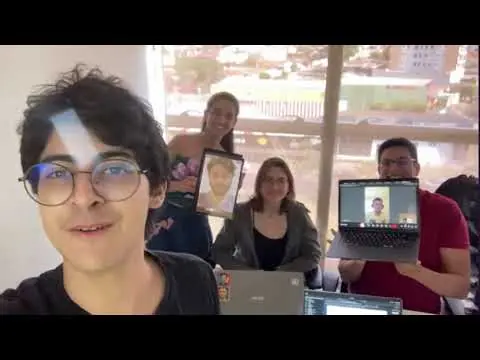 ▶ Watch the original demo on YouTube ↗
Project facts
- Track / challenge
- Seismic Detection Across the Solar System
- Team
- 6 people · BR
- Build
- software only
- AI
- ml model
Problem
Planetary landers cannot afford the power to send continuous seismic data home, yet only a fraction of it contains quakes.
Solution
A pipeline that band-pass filters Apollo and Mars InSight ground-velocity data, decomposes it with empirical mode decomposition, computes sliding-window energy per mode into a 2D matrix, and trains a U-Net encoder-decoder against Gaussian labels centred on each event's arrival time. A companion web page shows detected moonquake and marsquake types.
Demo moment
Not described in the sources.
Why it stood out
- organizer statedWon the award for the most innovative use of technology.Source ↗
- organizer statedUsed a deep neural network to locate seismic events precisely in time-series data, with advanced signal processing to isolate components of non-stationary signals.Source ↗
- team statedValidated on held-out data: 63 lunar events for training, 13 for validation, and both available Mars cases used only to check that a Moon-trained model generalizes.Source ↗
- curator inferenceThe write-up explains each step and why (filtering alone failed on low signal-to-noise, so they added decomposition), which makes the depth visible to expert judges.
Lessons for your next hackathon
- For a technology award, show the pipeline and the reason for each step, not only the result.
- State the validation split, especially when the target environment has almost no data.
- LATAM precedent: a team from Brazil won Best Use of Technology.
Similar situations
Projects that share domains, mechanisms or judging lenses — often with a different problem and stack.Tune the comparison.
 ▶ Video
Award winner · 2025
End-to-end pipeline that finds exoplanets in Kepler, TESS and JWST data and checks possible biosignatures against false positives.
Shared: domains space science · mechanisms visible engineering depth, trend wave timing · lenses scientific validity, technical depth · ai ml model · stack python
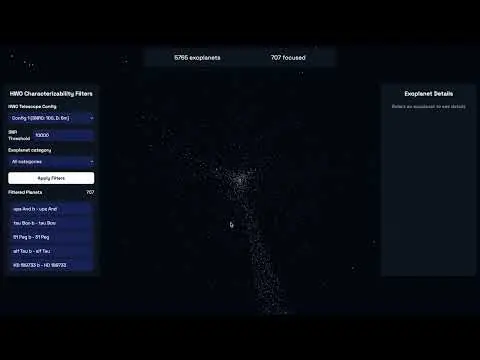 ▶ Video
Award winner · 2024
A 3D map of known exoplanets scored for habitability and detectability, to help the Habitable Worlds Observatory pick targets.
Shared: domains space science · mechanisms visible engineering depth, trend wave timing, complete submission package · lenses technical depth, scientific validity · ai ml model
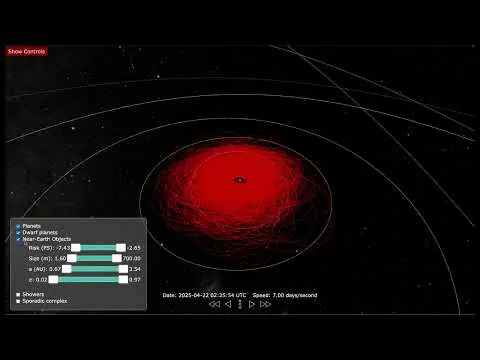 ▶ Video
Award winner · 2024
A physically based 3D orrery that puts near-Earth objects and meteoroid streams in one view to show the overlooked hazard to satellites.
Shared: domains space science · mechanisms visible engineering depth, complete submission package · lenses scientific validity, technical depth
Award winner · 2025
Interactive dashboard showing how radiation and microgravity together affect astronaut health at the molecular level.
Shared: domains space science · lenses scientific validity, challenge relevance · stack python
Award winner · 2025
Optimization model that decides when and where orbital data centers beat terrestrial ones for AI and Earth-observation compute.
Shared: mechanisms visible engineering depth, trend wave timing · lenses technical depth · stack python
Award winner · 2026
Nine substantial pull requests turning agentgateway from a model proxy into an identity-aware control plane for agents.
Shared: mechanisms visible engineering depth, trend wave timing · lenses technical depth
Sources
- https://www.nasa.gov/learning-resources/stem-engagement-at-nasa/nasa-international-space-apps-challenge-announces-2024-global-winners/ · official results · retrieved 2026-09-14
- https://www.spaceappschallenge.org/nasa-space-apps-2024/awards/ · official event page · retrieved 2026-09-14 — Award definition.
- https://www.spaceappschallenge.org/nasa-space-apps-2024/find-a-team/42-quakeheroes/?tab=project · project page · retrieved 2026-09-14 — Team-written method, training and validation split, links to notebook repository and web page.